Have you ever thought that on a daily basis you don't pay for googling things, your social media feed or half the apps on your phone? Everything just works, for free, no strings attached. Except there are strings, thousands of them, and they're all connected to your data.
Right now, companies you've never heard of are collecting, packaging, and reselling information about you: your name, your email, your location, your shopping habits, your browsing history, your estimated income, even your political leanings. This isn't speculation. It's an industry worth an estimated $200 to $400+ billion globally, and it runs almost entirely on one resource: you.
Today we want to show you exactly what your data is worth, who's buying it, and how to stay protected.
Data brokers are companies that aggregate personal information from public and semi-public sources, combine it into profiles, and sell those profiles to third parties - advertisers, insurers, lenders, political campaigns, background check services, and more.

Their sources are everywhere:
According to Federal Trade Commission findings, the largest data brokers operate with billions of individual records.
Here's where it gets concrete: researchers, regulators, and cybersecurity analysts have mapped out what data brokers typically charge for personal information, and the numbers might surprise you!
Raw Personal Identifiable Information - PII (a single data point like your name, email, or phone number) sells for roughly $0.001 to $0.05. Data markets consistently price basic personal information in the sub-cent range because it's abundant, easy to collect, and widely available. A basic PII bundle, name plus email plus a few demographic details, typically goes for around $0.03.
A combined consumer profile (your name, address, demographics, and inferred interests packaged together) is worth $0.50 to $5. This is the core product in the data broker economy. It's what powers marketing lists, audience targeting, and customer segmentation. Older benchmark estimates place a full profile at roughly $0.80, though richer datasets command more.
An enriched or use-case-specific profile (the one that includes predictive signals like credit risk indicators, purchase intent, or behavioral scores) sells for $1 to $5+. The price here depends heavily on who's buying and why. Background screening services pay roughly $0.50 to $2 per profile. Insurance and risk scoring companies pay $1 to $5. Political targeting operations pay $0.10 to $1.
At first glance, these numbers seem trivially small. A few cents here, a few dollars there…But the economics of data brokerage don't work the way you'd expect!
This is the most important thing to understand about the data broker model: your data isn't sold once.

Data brokers don't operate like a store where one record gets one buyer. They monetize through multiple channels simultaneously - per-record sales, CPM-based advertising models, and matching or enrichment services where your data is used to enhance someone else's dataset. A profile that sells for $1 in a single transaction might generate $10 to $100+ over time through repeated licensing and reuse.
And here's the real kicker. According to advertising ecosystem estimates, the economic value of a single user's data is approximately $263 per person per year. That value isn't extracted through one sale. It's generated through the entire chain of ads served, decisions influenced, offers personalized, and risks assessed - all powered by your information flowing through dozens of systems you never agreed to interact with.
So the math looks like this: data brokers charge cents to a few dollars per record. The businesses using that data extract hundreds of dollars in value annually. The gap exists because data is cheap to collect but incredibly powerful when aggregated, contextualized, and reused at scale.
Your personal information doesn't just live in the legal broker ecosystem. It also circulates on the black market, and the price difference between the two is striking. The same data point can be worth 10 to 100 times more when it moves from a marketing database to a fraud operation.
Email addresses sell for $0.01 to $0.10 through legitimate brokers, where they're used for marketing lists and outreach campaigns. On the black market, paired with a password, the same email fetches $1 to $10, because it enables account takeover attacks.
Phone numbers go for $0.05 to $0.50 in the legal market. In illicit marketplaces, they command $5 to $30, because they're useful for SIM-swapping, phishing, and social engineering.
Purchase histories are worth $0.50 to $5 to a data broker packaging them for ad targeting. On the dark web, that same behavioral data sells for $10 to $200, because it helps attackers build convincing fraud profiles of their targets.
Financial data - account indicators, spending patterns, credit signals cost $1 to $5 in the regulated broker market, where it's used in aggregate form. On the black market, usable financial credentials like bank logins or active card numbers go for $10 to $500+.
Full identity profiles, what the underground calls "fullz," a complete package of name, address, date of birth, Social Security number, and financial details, represent the widest gap. A data broker might sell a comparable (though less sensitive) consumer profile for $1 to $10. A fullz package on a dark web marketplace goes for $100 to $1,000+.
The fundamental difference isn't the data itself. It's what the buyer can do with it. Legal buyers use it for analytics, targeting, and segmentation, value extracted slowly over time through scale. Black market buyers use it for immediate exploitation - fraud, identity theft, account takeover. Higher risk means higher price.
If your data is only worth a few cents per record, how does this industry reach hundreds of billions of dollars? Volume.
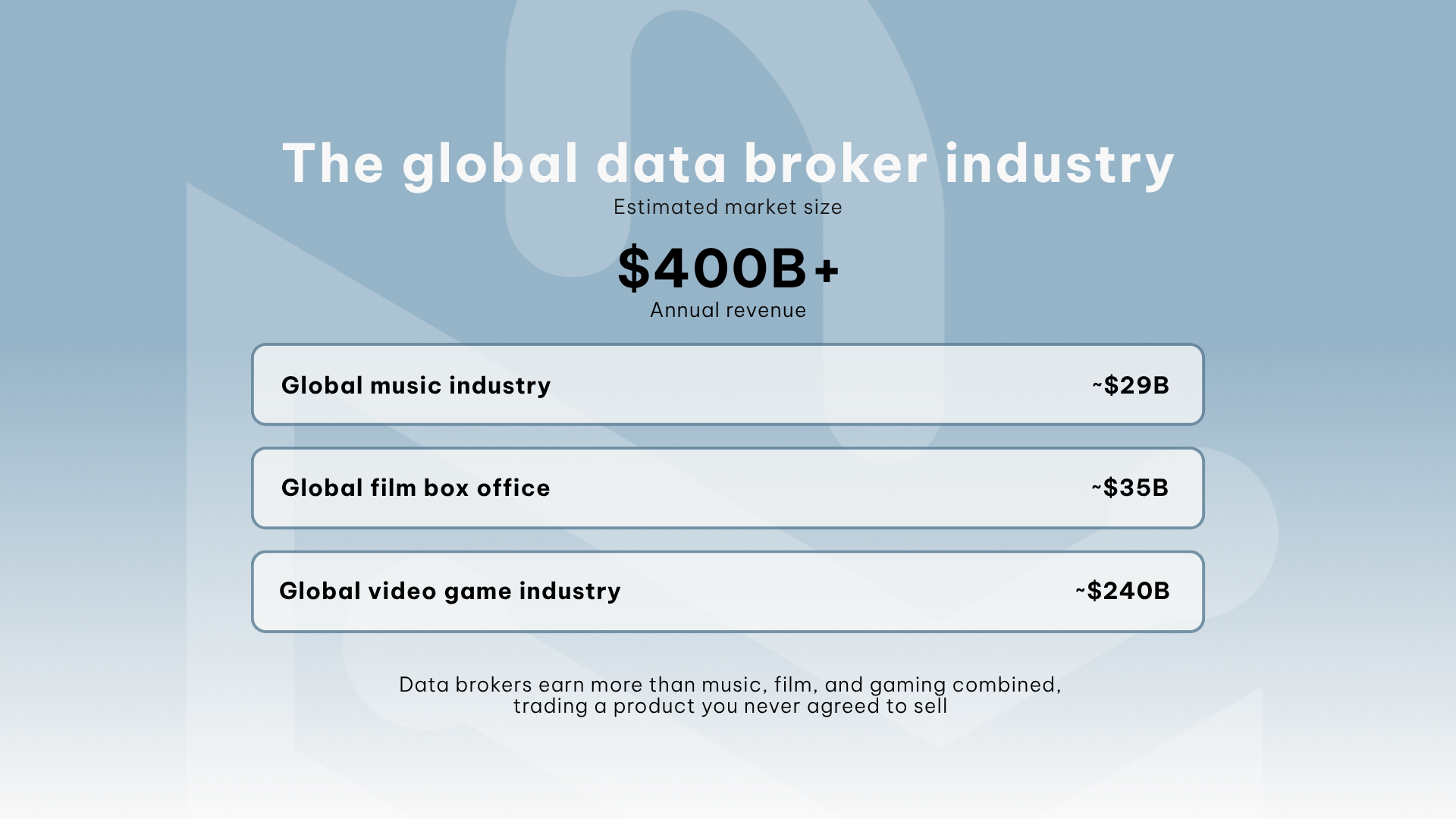
The global data broker industry is estimated at $200 to $400+ billion. That's not driven by expensive records, it's driven by billions of cheap ones, processed at scale, resold repeatedly, and fed into systems that turn low-cost inputs into high-value outputs. The economics are similar to advertising itself: no single impression is worth much, but trillions of impressions generate enormous revenue.
This is why individual data protection feels almost futile to many people. One record is nearly worthless. But in aggregate, your digital footprint - multiplied across platforms, enriched with behavioral data, and linked to real-world identities becomes a significant economic asset.
And the real issue isn't just the money you potentially lose. It's your privacy. Once your email is leaked, imagine the access it unlocks - your bank accounts, your social media, your cloud storage. A single breach can cascade into damages worth thousands of dollars, and some of that damage can't be undone at all.
Your PII is worth $0.001 to $5 per record to data brokers in most cases. To businesses using that data for advertising, risk assessment, and personalization, your information generates $100 to $300+ per year in economic value. On the black market, if your data is fresh and complete, a full identity profile commands $100 to $1,000+.
You are not the data broker's customer. You are the product that’s sold, resold, enriched, repackaged, and monetized over and over again.
It's nearly impossible to disappear from every data broker's database entirely. But you can make it significantly harder for them to build a complete, up-to-date picture of who you are. Check our practical guide to introduce habits that actually protect you.
Remember: privacy isn't a single tool or a one-time setup. It's built in layers, and the most effective approach is to use several of them together, every day.
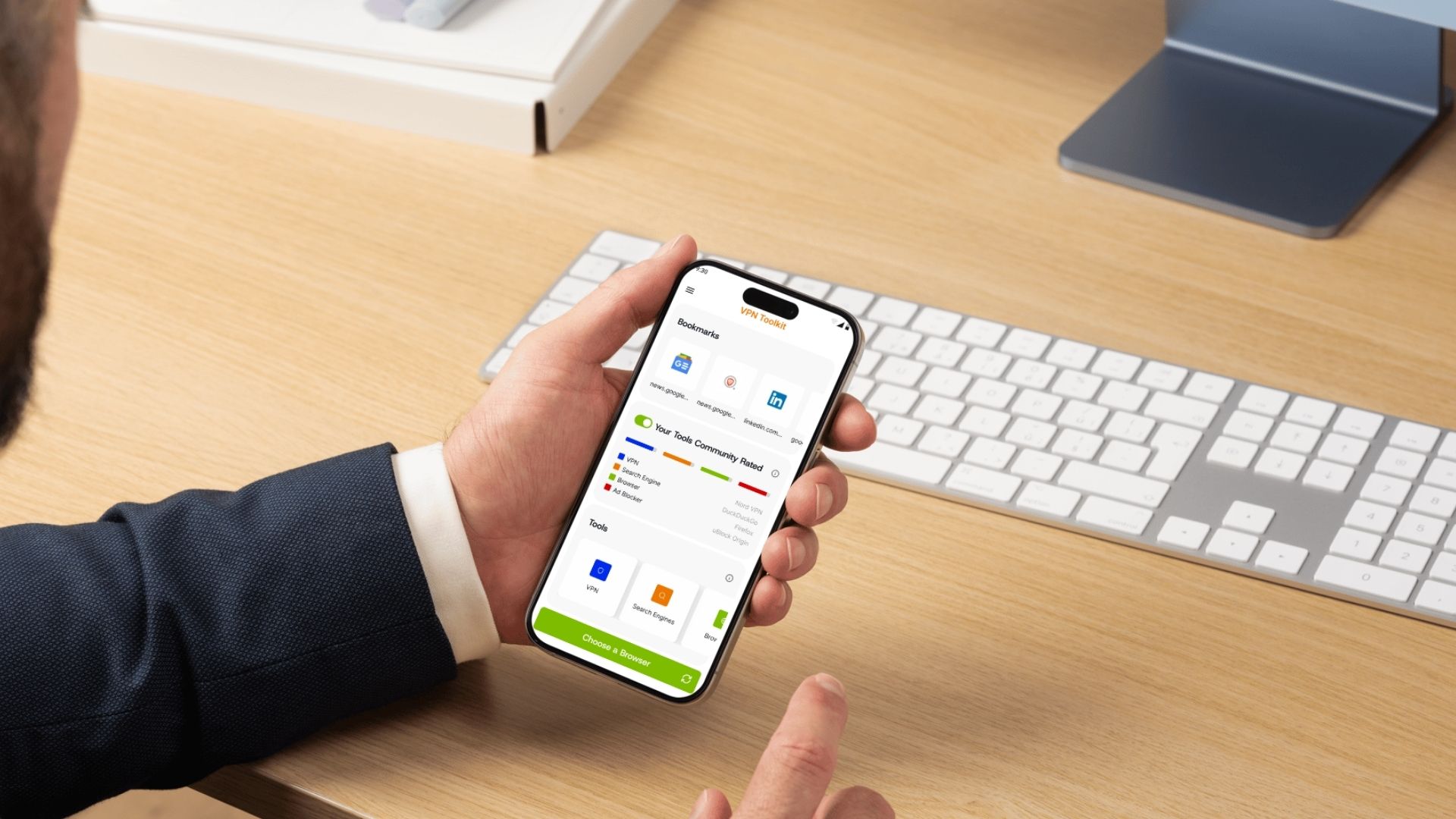
VPN Toolkit was built for exactly this kind of everyday protection. Instead of managing a scattered collection of privacy tools separately, it brings VPN access, privacy-focused search engines, secure browsers, and ad-blocking tools into a single hub, designed to make consistent digital hygiene something you actually maintain, not something you think about once and forget.
You don't need to be a cybersecurity expert to protect your data. You just need to understand what it's worth, and to whom.
There's a fundamental asymmetry in the data economy. Collecting your data costs almost nothing. Selling it generates cents. But using it at scale, repeatedly, across the entire advertising and decision-making ecosystem generates hundreds of dollars per person, per year. The data broker industry thrives in this gap between what data costs and what it's worth.
You can't change the structure of that market at once, but you can start with small steps, controlling how much of your information feeds into it. A few deliberate choices about how you browse, what you share, and which tools you use can meaningfully reduce what brokers know about you, and what they can sell.
Stay informed. Stay protected.



.svg)
